The PDP-11 and its buses
QUniLator is specialised to a family of machines that stopped being sold in 1995. This page is the background the rest of the manual assumes.
The PDP-11
Section titled “The PDP-11”DEC’s PDP-11s are 16-bit minicomputers, built from 1969 to 1995. More than twenty models, all software-compatible. Processor speeds ran from a few hundred kilohertz to 20 MHz, memory from 8 KB to 4 MB, and every kind of peripheral was attached to them — dozens of different tape and disk drives among them. Wikipedia lists 35 operating systems.
The architecture is genuinely beautiful, and it influenced a great deal of what came after.
Some PDP-11s are still doing serious work, mostly controlling special equipment. Far more are kept alive by enthusiasts, and they make good hobbyist machines: they are robust, mostly made of standard parts, and all the documentation and software is online — schematics, user manuals, diagnostics and operating systems alike.
How a machine is packaged
Section titled “How a machine is packaged”DEC packaged a 1970s PDP-11 in strict hierarchy.
At the top, a large machine is a row of 19-inch racks.
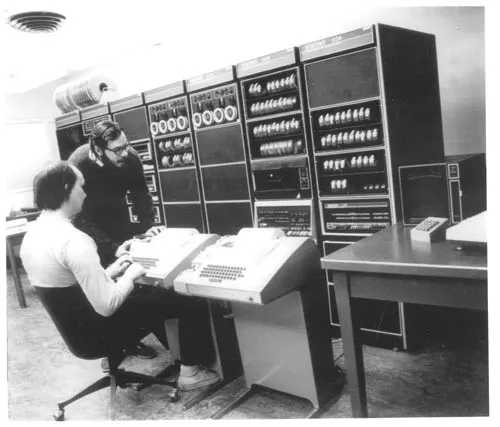
A rack holds a stack of boxes, which pull out on drawers. A box contains a power supply and one or more backplanes — arrays of contact slots wire-wrapped together.
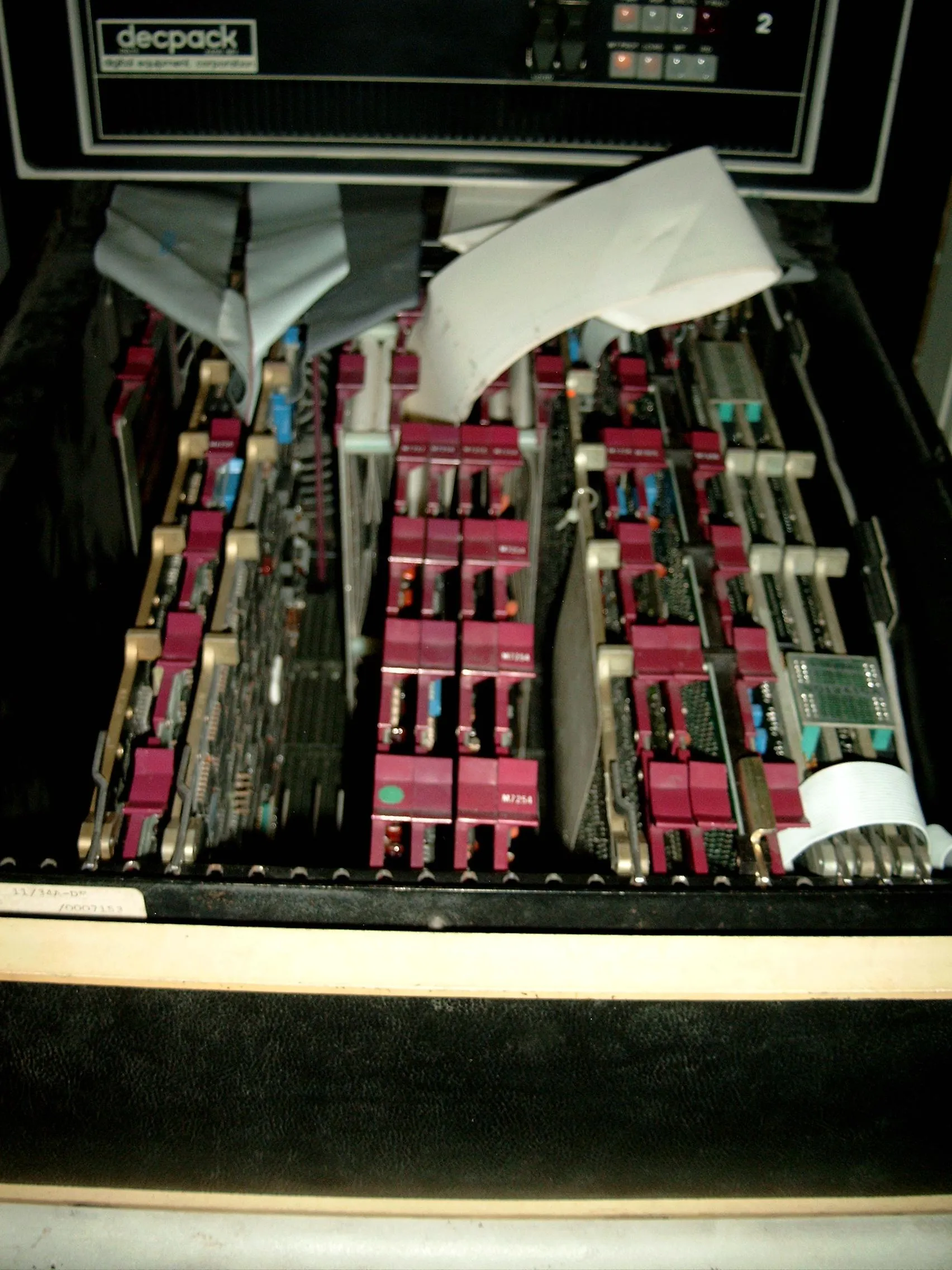
The backplane is populated with cards. Slots and connectors all follow DEC’s Flip-Chip standard.
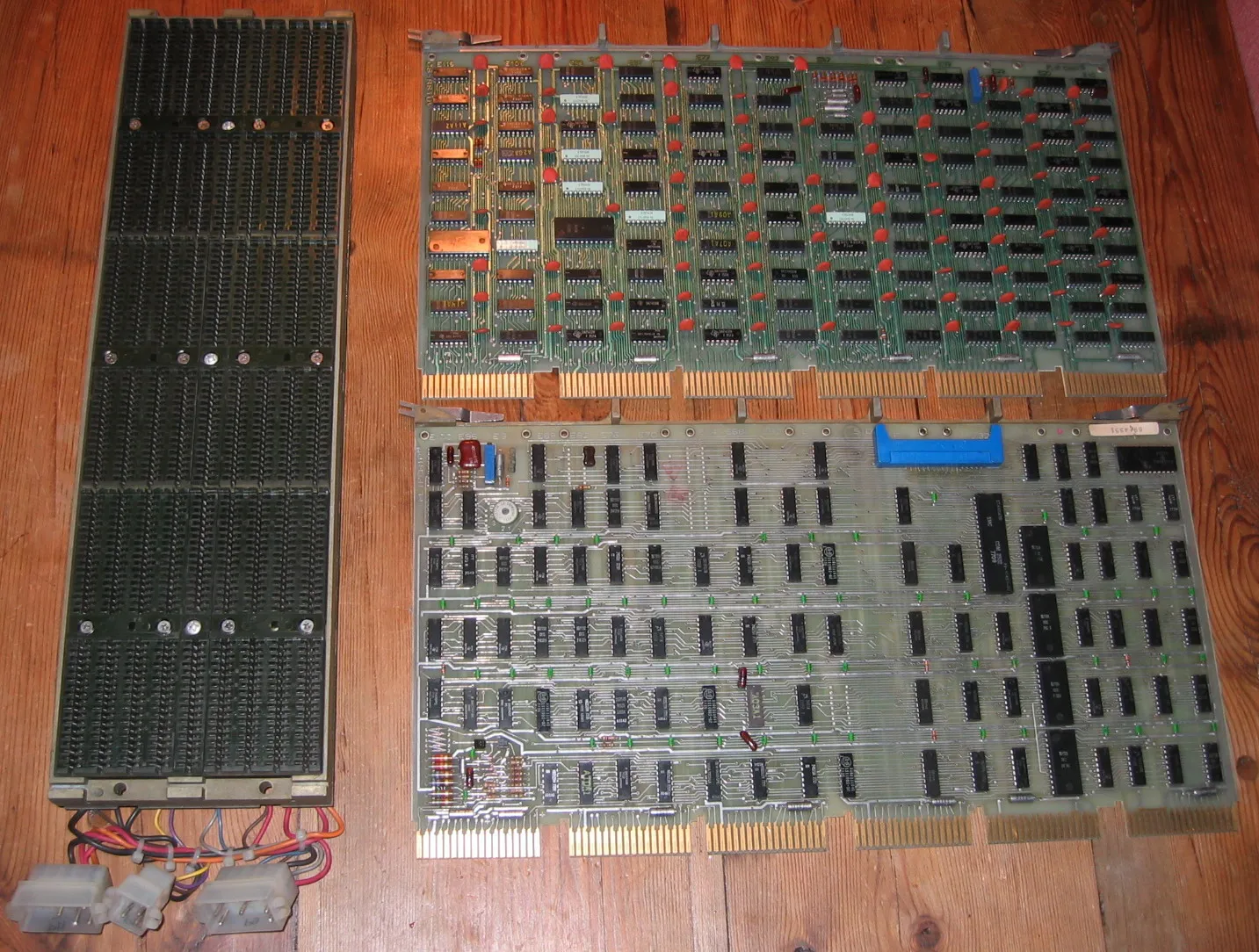
All those layers of packaging were expensive. Data General undercut DEC partly by using larger boards, which needed fewer boxes and fewer power supplies.
UNIBUS
Section titled “UNIBUS”The bus is much of why the PDP-11 line succeeded. UNIBUS — the universal system bus — connects everything uniformly. Main memory, mass-storage controllers, communications adapters, the system clock, the memory management unit and the processor’s own registers are all mapped into one address space, so the same instructions reach memory and I/O alike.
There are no I/O instructions in a PDP-11. There is no need for any.
Signals and the handshake
Section titled “Signals and the handshake”UNIBUS is 56 signal wires, most of them carrying 18 address bits and 16 data bits. The protocol is asynchronous, with a handshake between bus master and bus slave, so fast and slow devices share one bus without the fast ones being held back — and so propagation delay down a long cable is not a problem.
A typical transaction completes in about a microsecond. On a scope, a DATO — the master writing into a slave — looks like this:
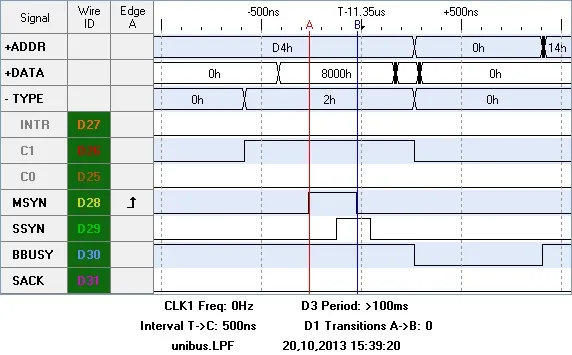
- The master asserts MSYN (cursor A), telling the slaves that an address and data for a new cycle are valid.
- Every slave latches the address; the selected one latches the data and acts on it — a memory card writes the word into its RAM. When it is done it asserts SSYN.
- The master takes the slave’s data, releases the bus and drops MSYN (cursor B).
- The slave sees the cycle accepted, releases the bus and drops SSYN.
That handshake is what the PRU implements, in software, on both cards.
Around 1975 DEC introduced a variant with fewer wires, better suited to very small PDP-11s: QBUS. The essential difference is that address and data are multiplexed onto shared DAL lines rather than each having their own, which is what makes the wire count so much lower.
The second difference is address width. UNIBUS is fixed at 18 bits — 256 KB. The larger UNIBUS processors (11/44, 11/70) reach 22 bits only over a separate memory bus. QBUS was designed from the start for 16, 18 or 22 bits, with the processor deciding which, and the upper 8 KB I/O page selected by a dedicated BS7 line rather than by address decoding.
That flexibility mostly hides inside the processor, but it does not hide from a card that has to be both master and slave — which is why a QBone must be told the width rather than inferring it. See Fitting it to a backplane.
Grant chains
Section titled “Grant chains”Both buses acknowledge interrupt and DMA requests by routing the processor’s acknowledgement — the grant — not to every requesting card in parallel, but to the first card on the bus. A card that did not make the request must forward the signal to the next, and so on down the line. That is the grant chain, and unoccupied slots must forward it with continuity cards.
This matters more than it sounds. The card closes the grant chain in software, by watching the incoming pins and forwarding the signals — so while QUniLator is not running, the chain through its slot is open. It is a common reason for a machine that will not start with the card fitted; see the FAQ.