Getting a card
The hardware and the software are both open source, under the BSD licence: you may forward, modify and sell any of it, as long as the copyright notice stays visible. There is no warranty.
That leaves three ways to get a card.
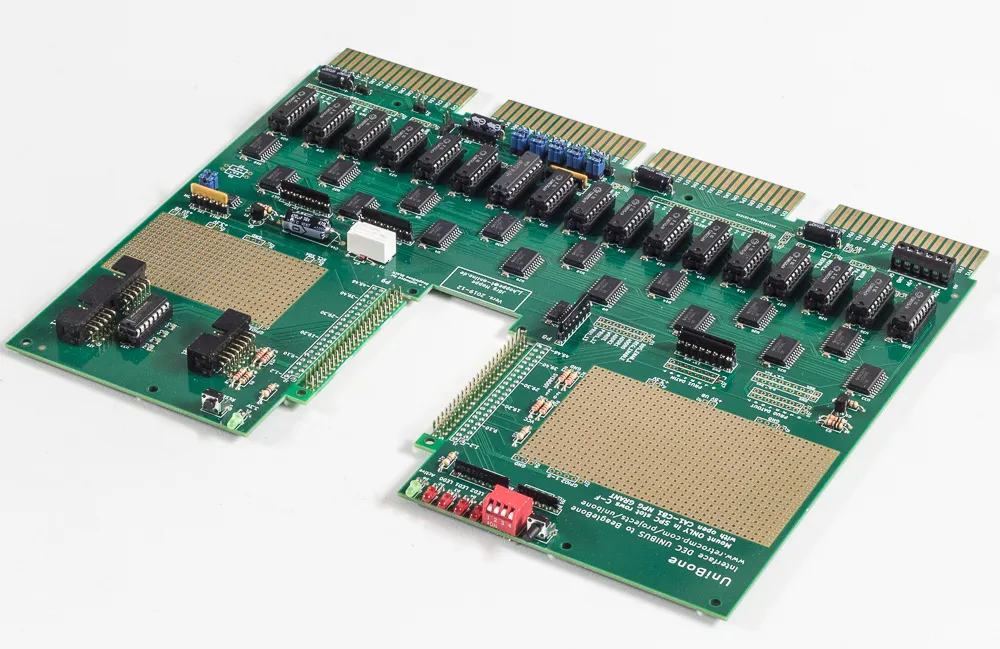
Built and tested
Section titled “Built and tested”Jörg Hoppe builds cards to order. Prices are indicative and move with component costs — ask when you enquire.
| UniBone | QBone | |
|---|---|---|
| Built and tested | €300 | €300 |
| Kit, SMD parts already mounted | €180 | €180 |
The BeagleBone Black is not included in either — reckon on about €70, and it moves day to day. Shipping runs about €16 within the EU and around €60 internationally; shipping to the US is intermittently impossible depending on tariffs.
Contact Jörg through retrocmp.com to order.
Build your own
Section titled “Build your own”Blank PCBs are not sold, but the Gerbers are yours to send to a fabricator. The whole KiCad project — schematic, PCB, the two CPLD projects and the 3D-printable BeagleBone mount — is published:
- PCB design files — files.retrocmp.com/qunibone-misc/01.01_pcb/
- Source — github.com/QUniBone/QUniLator
The design is deliberately low-tech: through-hole wherever it can be, standard
TTL, no FPGA, and nothing fine-pitch. It can be assembled by hand. The spacers
for the BeagleBone mount are under bbbadapter in the PCB archive.
Cards sold as kits arrive with the CPLDs already programmed. If you fabricate your own you will need Lattice Diamond and a programming adapter to load them.
What else you need
Section titled “What else you need”- A BeagleBone Black. Not a Pi — see Why a BeagleBone.
- A microSD card, 8 GB or larger. The release takes a couple of gigabytes and the rest is where your disk and tape images live, which is what the 8 GB is for. A 4 GB SD card boots and runs, with little room left for images. Buy a good one: unlike in a camera, Debian is on it the whole time, and speed and reliability both matter.
- A 90° angled Ethernet plug, if the card is going into a closed DEC case.
- Grant continuity cards for the empty slots — G727 on UNIBUS, G9047 on QBUS.
- A terminator, if the card is going into an empty backplane for testing. It must be passive: resistors only, no boot ROM.
The panel box
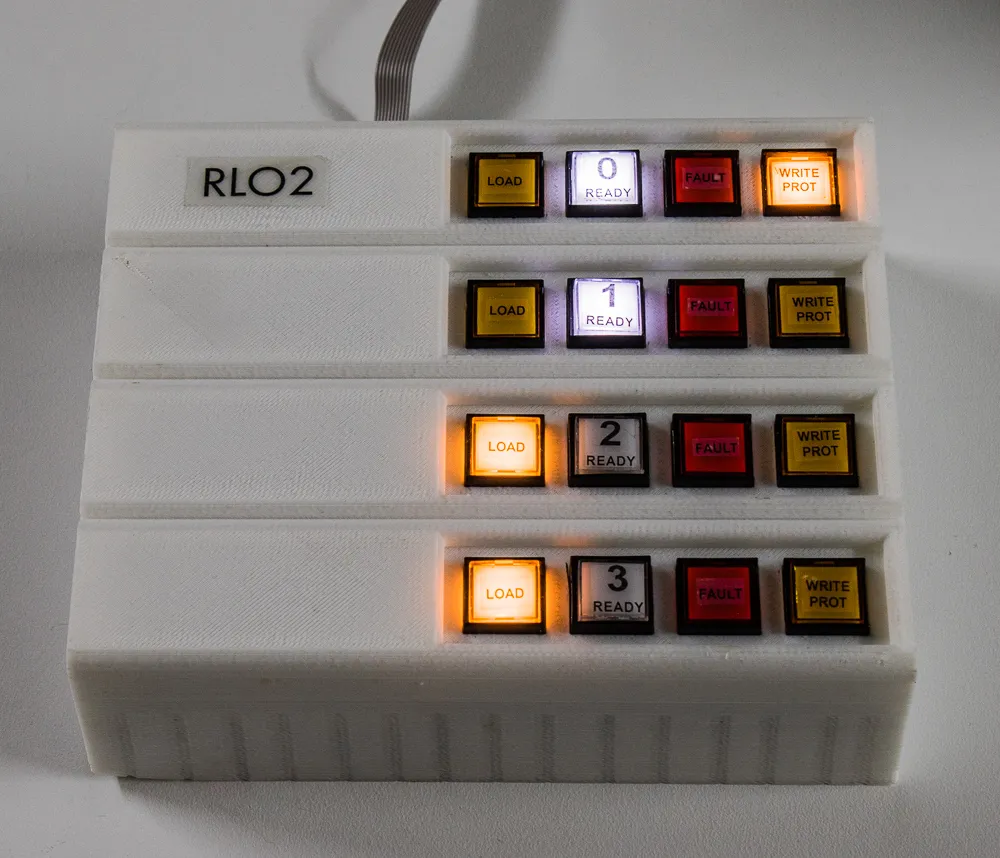
Section titled “The panel box”An optional lamps-and-switches box attaches over the I²C bus, giving an emulated drive real controls. The PCB is a generic 16-lamp, 16-input GPIO expander rather than anything RL02-specific, and several boxes daisy-chain.
A complete kit — 3D-printed case, PCB, parts, buttons, lamps, cables and adhesive lamp labels — is €160; assembled and tested €220.
Then what
Section titled “Then what”Once the card arrives: install the software, then run the acceptance test before trusting it in a machine you care about.