What is on the card
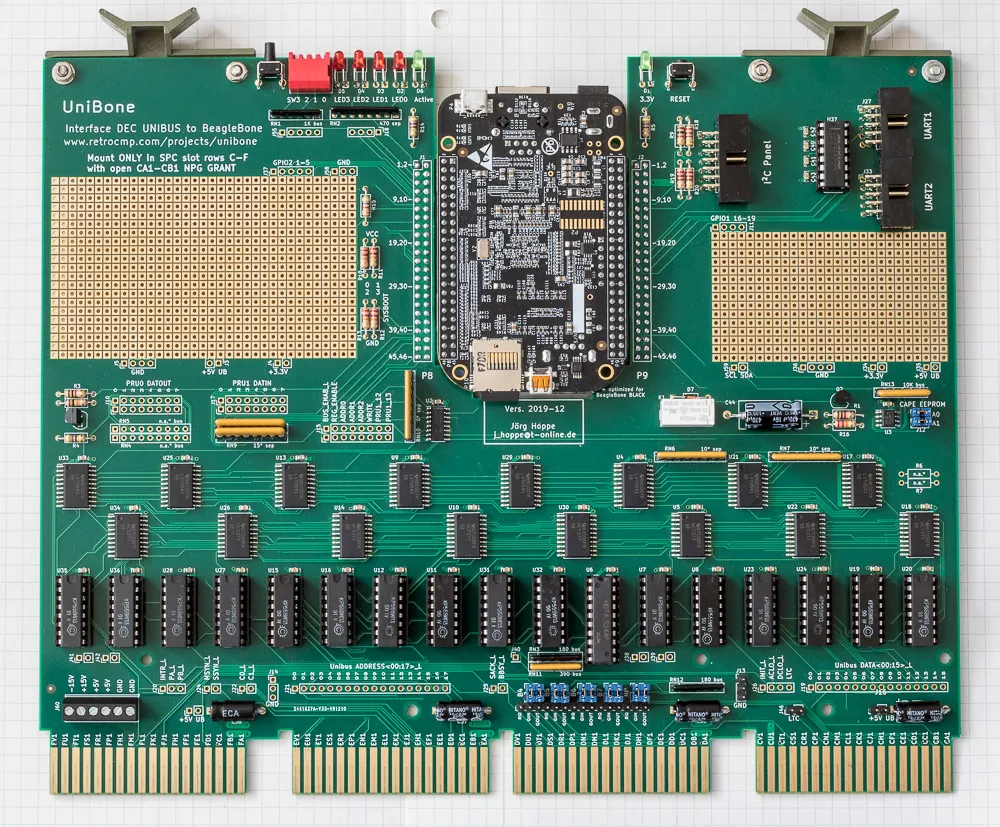
The card looks retro, and that is not coincidence. It deliberately mimics a 1980s quad card: through-hole parts wherever possible, silver tantalums at the slot fingers — sometimes taken off old boards — and that green. Standard TTL, no FPGAs. No white or blue LEDs. BERG-style connectors, big transistors and resistors. Later revisions carry more SMD and a different BeagleBone mount.
What is on it
Section titled “What is on it”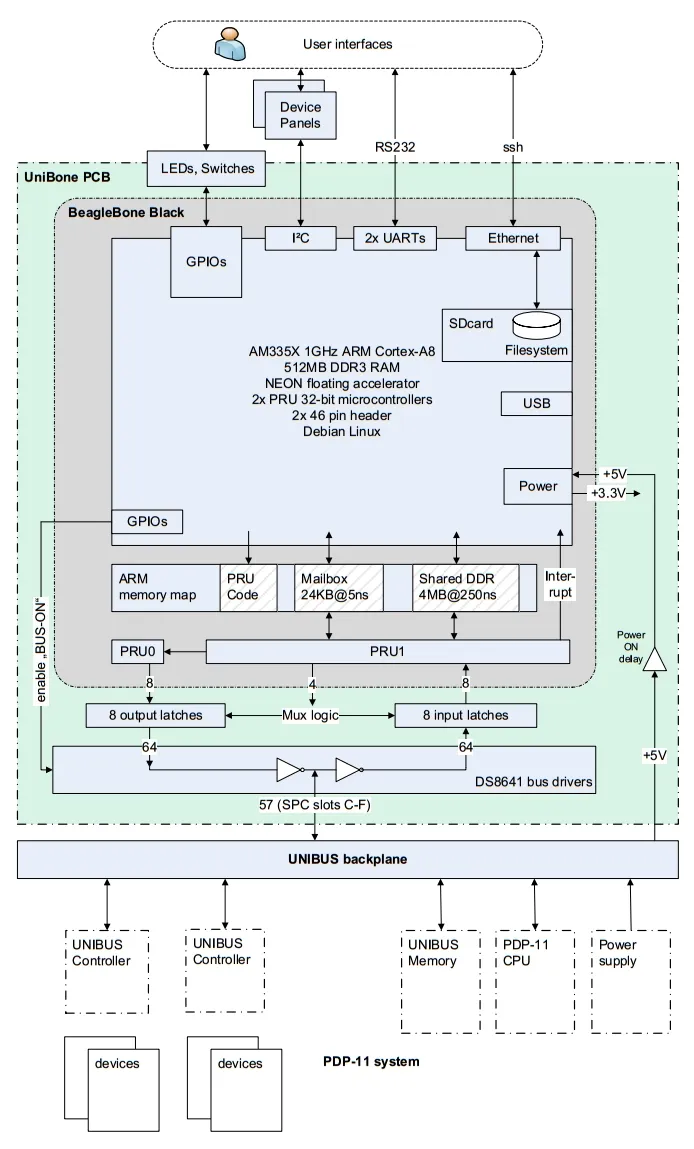
Bus interface. Every bus signal line is connected bidirectionally through DS8641 drivers, so the card can be a slave (answering as a memory location or device register) and a master (arbitrating, interrupting, doing DMA). Even ACLO and DCLO can be driven, which is how the card commands the processor through a power-cycle reset. A global driver enable effectively unplugs the whole card from the bus. On driver substitutes, see Bus drivers.
The PRU datapath. PRU0 and PRU1 each have 32 dedicated high-speed GPIOs, but only some reach the BeagleBone’s pin headers — 8 outputs on PRU0, and 4 outputs and 8 inputs on PRU1. These 8-bit, 100+ MHz ports are widened to 64-bit, 10+ MHz ports by an array of register latches.
PRU GPIOs are best driven in one direction only: flipping a pin from input to output costs on the order of a microsecond, against 5 ns for normal operation. So there are two separate unidirectional datapaths — one in, one out — meeting at the bidirectional bus drivers. The whole bus protocol lives on PRU1; PRU0 only forwards data to its GPIO outputs.
Level conversion. Old 5 V logic accepts 3.3 V drive, losing some noise margin. The other direction needs care: 5 V-tolerant 74LVTH-family latches protect the BeagleBone’s inputs.
Power. +5 V comes from the slot; the BeagleBone makes its own 3.3 V. Because a vintage DEC supply can behave arbitrarily on power-on and the DCLO “power good” signal is under application control, a relay delays +5 V by about a second to give the BeagleBone a clean ramp. The slot’s other rails are routed to a power connector, so the card can feed a standalone backplane.
ARM↔PRU communication runs over shared memory. The small PRU-local RAM is mapped into the ARM address space as a command and data mailbox; the large ARM DDR is reachable by the PRUs more slowly, across several cache and bus layers, and is what backs emulated memory. When PRU1 decodes a register access to an emulated device, it signals the ARM software with an interrupt.
Everything else. LEDs and switches on ordinary GPIOs. Two patch fields with GND, 3.3 V and 5 V for your own circuitry. Labelled pin headers on every high-speed PRU signal and every bus signal. A powered I²C bus for lamps-and-switches panels. Two UARTs on DSUB-9 connectors, for a Linux session on a real VT100 or for emulated serial controllers. Ethernet is the intended way in — Wi-Fi would not work inside an all-metal DEC case.
Mechanics
Section titled “Mechanics”A BeagleBone is only slightly taller than a DEC board slot, and neighbouring boards usually have space above their ICs because DEC logic ICs are not socketed. That is the gap this design exploits.
The bone is not mounted on top of the PCB but hangs upside-down in a cutout, held at the right vertical alignment by length-reduced pin headers and small piggyback PCBs. Fiddly and time-consuming to build — and it is why the card fits a standard Flip-Chip slot at all.
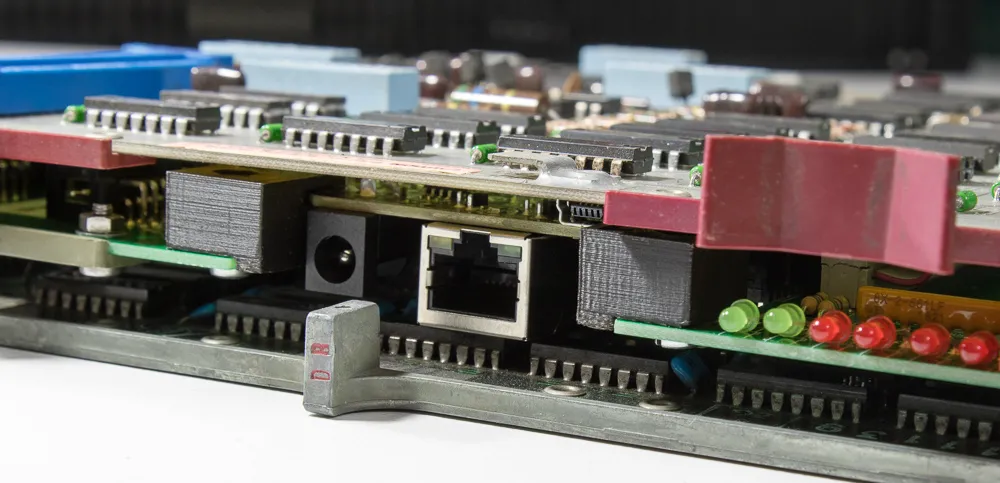
With a 90° angled Ethernet plug the card fits even in a closed DEC BA11 case, and the SD card slot and USB port stay accessible.
Useful without any parts on it
Section titled “Useful without any parts on it”An unpopulated PCB still earns its slot.
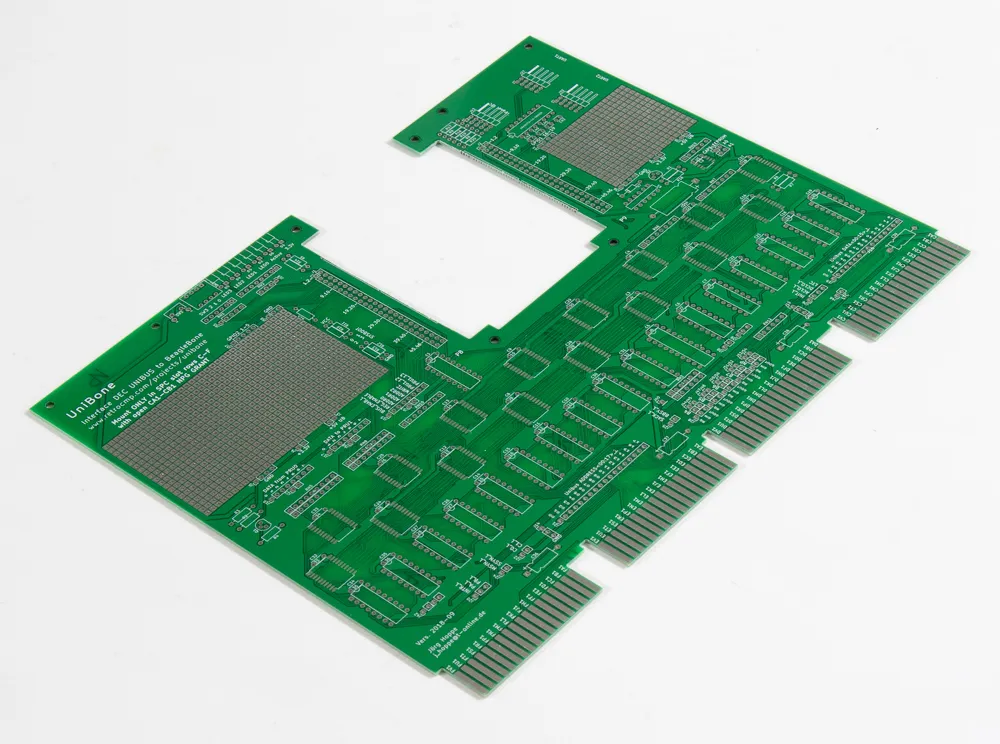
It works as a long grant continuity card with an added NPG-closing function — the card is also a G727. And the labelled slot fingers, bus pin headers and patch fields make it a bus prototyping board; fit the DS8641s and you have a driver stage as well.
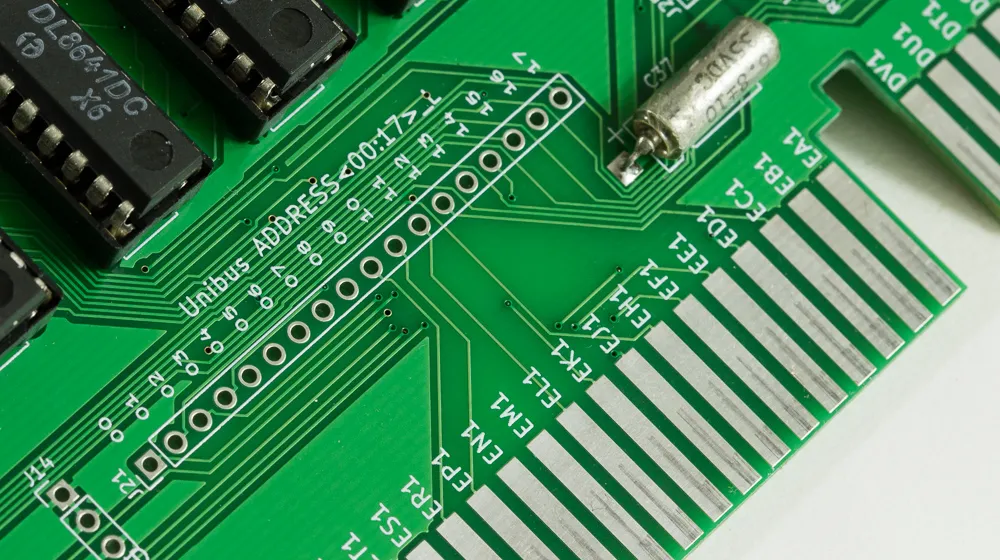
Wrap yourself a bus adapter for your logic analyser off those headers, and your bench will look marginally less like a B-movie laboratory.
Design files
Section titled “Design files”Schematics are KiCad, and the whole project is published — see Getting a card.