What QUniLator is
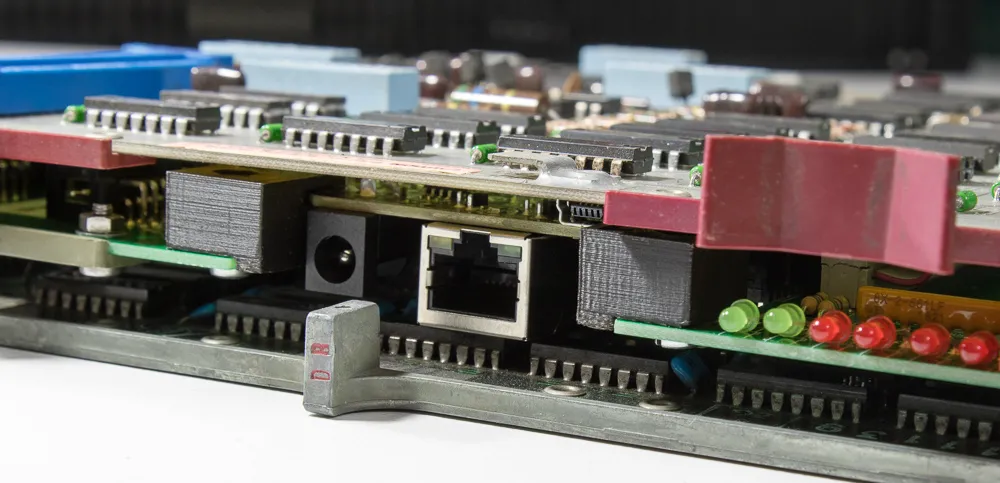
QUniLator is a bridge between a DEC bus and a modern Linux environment. Its primary application is device emulation: it presents controllers, drives, memory and terminal lines to a real machine, over the real backplane, as cards that answer like the originals.
It runs on a BeagleBone Black carried by one of two cards.
Everything above the bus wires is shared: the same BeagleBone, the same software, the same web interface, the same SimH-compatible media files. Which is why there is one manual rather than two — see Choose your card if you are deciding which you need.
Not just another device emulator
Section titled “Not just another device emulator”Several device-emulator projects exist. QUniLator differs in a few deliberate ways:
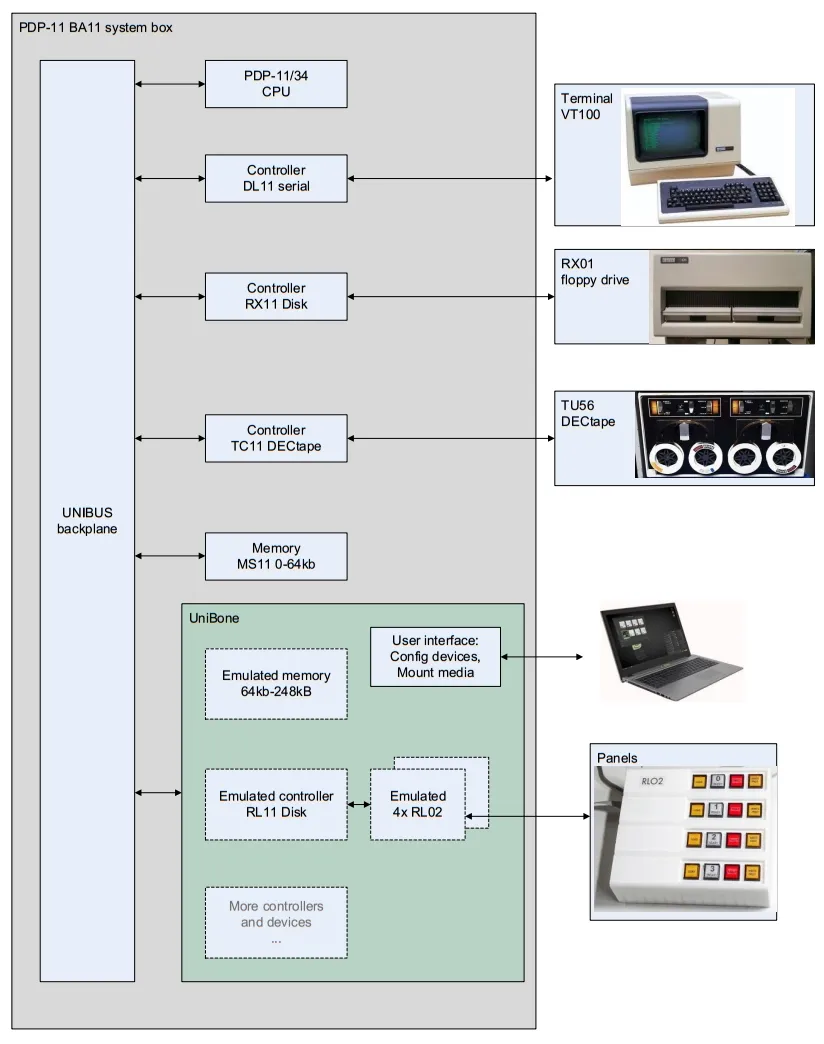
- It emulates device and controller together at the bus level, rather than a drive hanging off a genuine DEC controller card. Nothing between the machine and the emulation but the backplane.
- It is configurable: arbitrary devices in parallel, up to a whole system.
- A full Linux sits behind it, so the BeagleBone can run SimH, complex diagnostic software, or a network service alongside the emulation.
- Emulated devices can drive real hardware — the BeagleBone is full of interfaces, and the card carries patch fields and a powered I²C bus for lamps-and-switches panels.
- All programming is plain C/C++. No FPGA.
- The hardware is simple enough to be a do-it-yourself kit: through-hole where it can be, hand-solderable, no fine-pitch parts.
The economics matter too. Bus controller cards that interface to any modern standard are rare and expensive — a UNIBUS SCSI or Ethernet card runs to four figures when one can be found at all.
What it emulates today
Section titled “What it emulates today”Grouped by what the machine sees. This is a summary; the per-device reference, generated from the source, is still to come.
| Disk | RL11 with RL01/RL02 · RK11 with RK05 · MSCP (UDA50 and friends) · RS11/RF11 DECdisk · RX11 and RX211 with RX01/RX02 floppies |
| Tape | TM11/TS11 · TMSCP |
| Memory | a card’s worth of the BeagleBone’s DDR, at an address range you name |
| Serial | DL11-W · DZV11 · DHV11 |
| Network | DELQA · DEUNA, bridged to the host LAN |
| Bootstrap | M9312 · MRV11-D · MXV11-B2 |
| Clocks | KW11-L line clock · KW11-P programmable clock |
| Graphics | VCB01 / QVSS framebuffer |
| Other | KE11 EAE · a “demo” device exposing the card’s own LEDs and switches · lamps-and-switches panels over I²C |
Why a BeagleBone
Section titled “Why a BeagleBone”The usual first question is “why not a Raspberry Pi?”. What this job needs is not CPU power or graphics but fast, jitter-free GPIOs, and that is the BeagleBone’s particular strength.
The Sitara AM335x carries two PRUs — Programmable Realtime Units — 200 MHz 32-bit RISC cores with their own GPIOs, built for bit-banged protocols. They have no pipeline and no cache, so an opcode always takes 5 ns. A square-wave loop on a PRU pin runs at 66 MHz.
Speed matters less than determinism. A Linux user process gets descheduled; signals it produces jitter, and inputs it samples lose edges. The PRUs run independently of Linux timing, so the bus protocol holds its timing regardless of what the ARM side is doing. The ARM runs Debian with the RT patch and talks to the PRUs through shared memory.
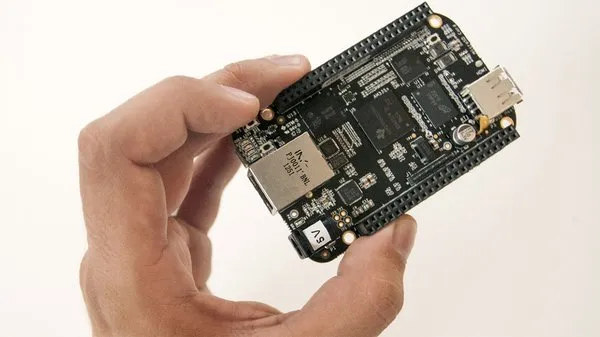
Against an “ARM + FPGA” design, the BeagleBone wins on the things this project cares about: it is a complete Linux platform with a community behind it, small enough for a Flip-Chip slot, needs no 100-pin fine-pitch parts on the PCB, and compiles its own software in minutes rather than synthesising a bitstream.
The names
Section titled “The names”| QUniLator | the software, and this site |
| UniBone | the UNIBUS card |
| QBone | the QBUS card |
| QUniBone | the GitHub organisation, and the older combined name for the two cards |
The glossary carries these and the other words this manual uses narrowly — device, machine, configuration, bundle.
The project is BSD-licensed — hardware and software both. See Credits and licence.