Bus drivers
UNIBUS and QBUS lines are terminated with resistor pairs of roughly 200/400 Ω — a low impedance that ordinary TTL can neither drive nor receive at the right thresholds. Driving the bus alone costs several watts, and burnt-out bus drivers are a common reason for a dead PDP-11.
DEC’s answer was a special line driver/receiver, the DS8641, and that is what the cards use.
The supply problem
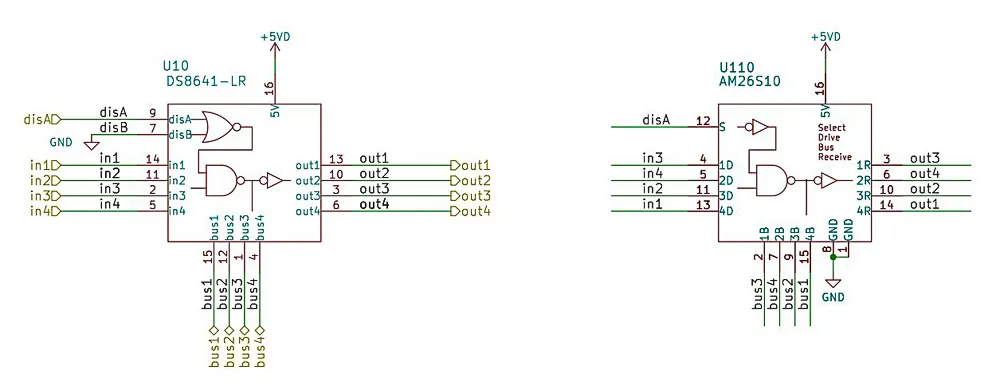
Section titled “The supply problem”DS8641s and their compatibles — DL8641, the Russian КР559ИП3 — get harder to find every year. So the 2023-04 card revision carries parallel sockets for the DS8641 and for the AM26S10, which has a different pinout but is designed for the same job and also contains four transmitter/receiver pairs.

The 75138 is pin-compatible with the AM26S10. Neither is fully electrically compatible with the DS8641:
| Switching time | |
|---|---|
| DS8641 | 30 ns |
| 75138 | 20 ns |
| AM26S10 | 10 ns |
The usual “faster is better” does not hold here. Besides differing receiver thresholds, faster switching produces more ringing. On specification the 75138 is the closer match; on availability the AM26S10 wins — it is still in production and stocked in DIP and SMD.
The chips can be mixed freely on the card. You will not want to.
Why this is not purely digital
Section titled “Why this is not purely digital”Bus signals switch in a few hundred nanoseconds, and a sharp edge carries frequencies at or above 100 MHz. At that point transmission-line behaviour applies: a pulse reflects off a cable end whose termination does not match the driver’s impedance, and the reflection shows up as ringing — one clean pulse transmitted, several received.
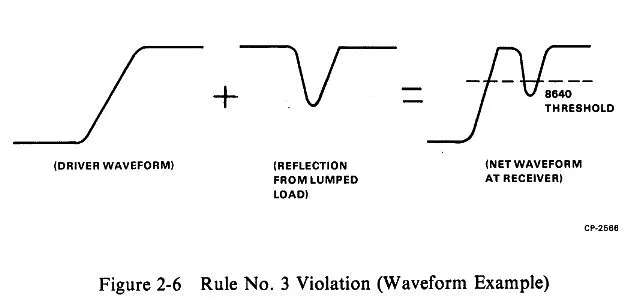
That is not cosmetic. Address lines on the QBUS BDAL are latched by BSYNC; a bouncing BSYNC latches bus noise over the valid address that was latched a moment earlier.
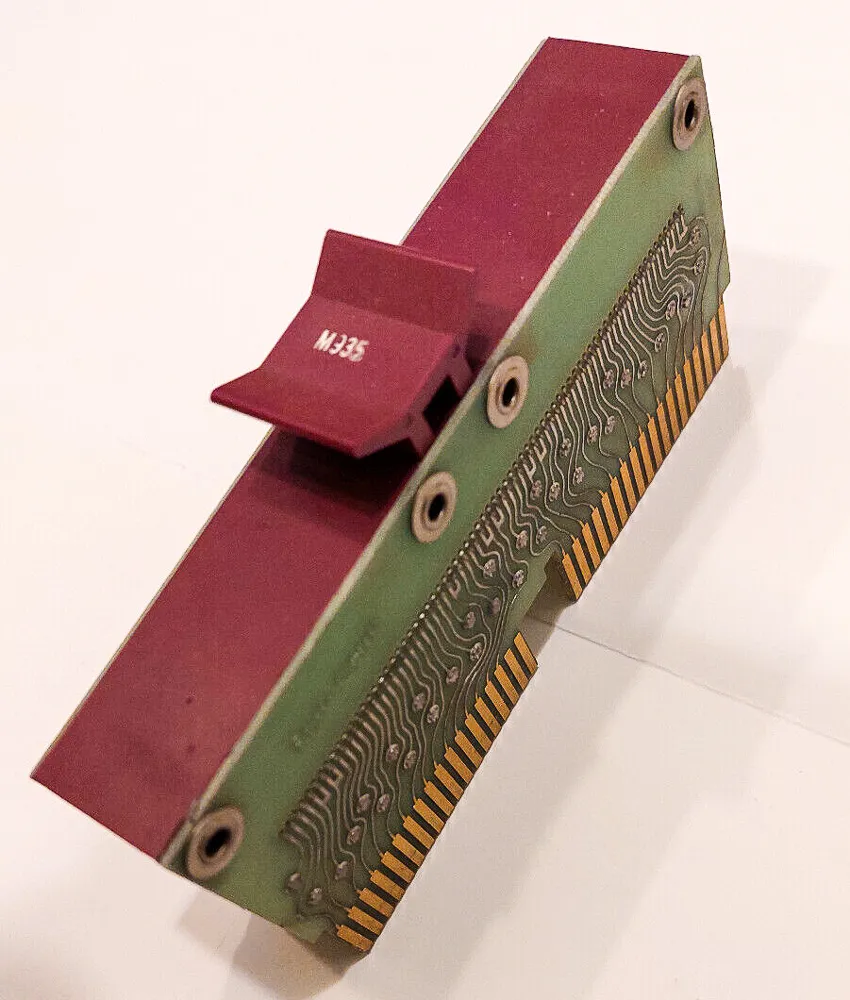
DEC knew. The UNIBUS Troubleshooting manual tells field engineers to measure ringing and suppress it with backplane jumper cables of different lengths — which is what is hidden inside an M9202, and why there are several M9202 variants carrying different amounts of cable.
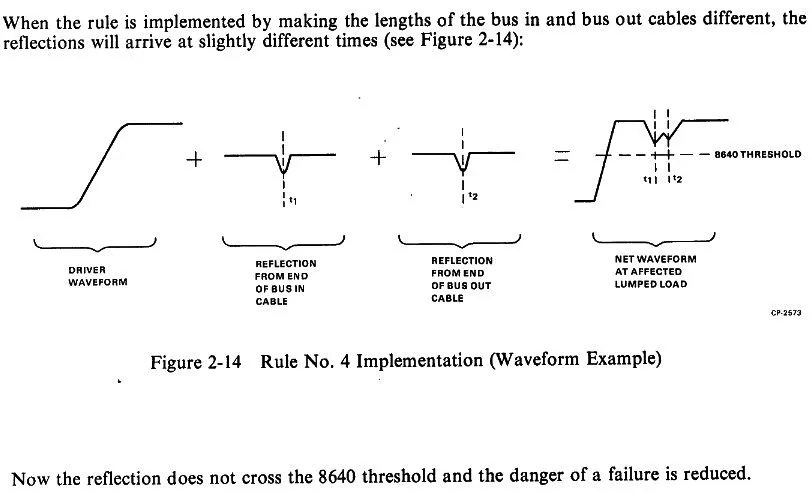
This is also why the receiver’s input threshold matters: these signals are not “all digital”. The exact properties of the driver matter.
Where an alternative is safe
Section titled “Where an alternative is safe”The two buses share electrical specifications but not typical installations.
Bottom line: alternative bus drivers work on small UNIBUS systems and comfortably on QBUS ones — testing bears that out. For a UNIBUS system with BC11 cables, stay with DS8641.